2026 Legislative Session Roundup
There is a spirit of optimism required to achieve meaningful criminal legal reform at the state level. The optimism is not built from false hope, but from a recognition that meaningful reform is required to ensure we treat people in the system with the dignity and respect they deserve as fellow human beings. The optimism comes from a sense that when people in power understand that dignity and humanity are the goals, that they can and will be convinced reform is necessary.
It is with this sense of optimism that Justice Forward Virginia began the 2026 session. The General Assembly had already passed many of our reforms in 2024 and 2025, and we were confident the 13 new House members would join our efforts. The only question was the governor. Before she was elected to Congress and before her time in the CIA, Abigail Spanberger served as an officer for one of our nation’s oldest law enforcement agencies, the United States Postal Inspection Service. Her campaign commercials featured law enforcement officers and stories about her father, a career police officer who also worked for the USPIS. Last but not least, Spanberger touted the August 2025 endorsement of the Virginia Police Benevolent Association, which represents nearly 11,000 law enforcement officers in the Commonwealth.
Support for law enforcement and support for criminal legal reform are not mutually exclusive aims. However, a reality of the Virginia General Assembly and statehouses across the country is that the chief opponents of criminal legal reform are law enforcement and their lobbyists. Criminal legal reform challenges government power. Those who wield power seldom yield it without a fight.
After we met with the governor’s staff and General Assembly leadership before session, we remained optimistic. Nothing about those conversations told us that our legislative priorities were too ambitious. On the contrary—the General Assembly had already passed many of these bills once or even twice, only to meet the veto of the previous governor.
We understood at the outset that 2026 would not be a return to 2020-21, when we brought Virginia’s criminal legal system out of the Stone Age. We were told by our friends that defelonization of all drug possession—already the law in about half of U.S. states, including some very blue and very red ones—was a nonstarter for the 2026 session. Once the session got underway, we again adjusted our expectations when bills to provide a Second Look for people who have served long prison terms and our bill to repeal mandatory minimum sentences were removed from the docket, as crime panic peddlers stoked fear about these bills online. In the midst of thoughtful conversations with new lawmakers and their staff, we recognized that much more education is needed to help people in power understand the injustices caused by removing a judge’s ability to consider the facts and circumstances of each case before imposing a sentence.
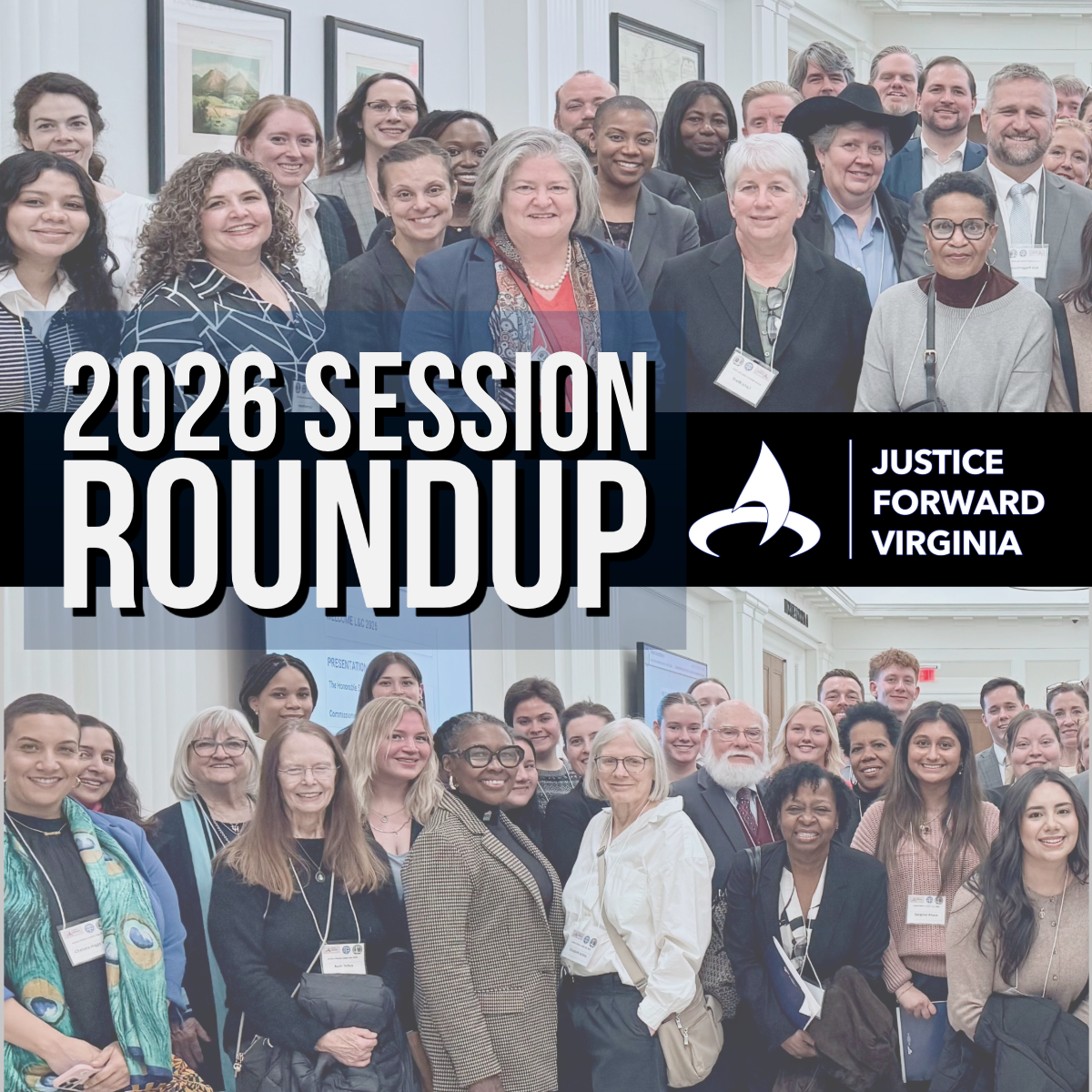
Nonetheless, we did what Justice Forward Virginia has become known for: punching well above our weight at the General Assembly. As we have always done, we held another outstanding Justice Reform Lobby Day with our partners from the beginning, the Virginia Association of Criminal Defense Lawyers and the National Association of Criminal Defense Lawyers. Joining with criminal legal reform advocates from across Virginia, we spoke directly to lawmakers about the importance and urgency of these evidence-informed policies. By crossover, the ostensible midpoint of session, the House had passed our bills to defelonize possession of drug residue, protect people with developmental disabilities and mental health disorders from felony assault on law enforcement charges, ensure deferred dismissals don’t depend on payment of court costs, preserve access to diversion, fix discovery, ensure counsel at first appearance, reform failure to appear, ensure confidentiality for restorative justice, reform the Judicial Inquiry & Review Commission, keep prior conviction evidence away from juries at trial, and provide necessary fixes to some of our most significant reforms from 2020–21: aligning the new classes of robbery with the rest of the code, protecting technical probation violation reform, and updating our mental health evidence fix. And although hampered by bill limits, by crossover the Senate had passed several of the same reforms, as well as a critical bill to ban 4th Amendment plea bargain waivers.
When the General Assembly adjourned in March, it had passed 13 of our 20 priority bills. We were poised to have our most successful session ever. Throughout the session, the governor and her staff had remained quiet about criminal legal reforms. But they had largely done the same in other policy areas, too.
Then came the governor’s actions. Not quietly, either. Her vetoes came in a press release on a Monday evening in April. "Governor Abigail Spanberger today vetoed legislation that would … make it harder for Virginia’s criminal justice system to hold offenders accountable.” All three of her “public safety” vetoes were Justice Forward Virginia priority bills: House Bill 637, our bill to defelonize possession of drug residue; Senate Bill 23, our bill to ban 4th Amendment plea waivers, and SB 764, a bill to allow defendants to directly ask courts to defer and dismiss charges over a prosecutor’s objection. HB 637 and SB 764 got significant bipartisan support in the General Assembly. SB 23, which was passed and vetoed in 2024, had been revised this time to allow waivers for people convicted of various child sex crimes.
In addition to the vetoes, the governor attached a reenactment clause to our bill to allow defendants to withdraw notice of jury sentencing, effectively killing the legislation. She also recommended amendments to our bill to protect people with disabilities and mental health disorders that would have rendered the legislation meaningless. After the General Assembly—and the governor’s staff—heard our concerns about the amendments, the legislature rejected them in April, sending the bill back to the governor in its original form, which had bipartisan support in both chambers. She vetoed the bill with a pledge to continue working with us to address the issue in the future.
There were no meaningful justifications to veto our legislation, and thus no reason for us to give up on our priority bills. In a concurring opinion published June 18 and joined by two of his colleagues, Justice Neil Gorsuch questioned the governor’s veto of our 4th Amendment plea waiver ban. In Hunter v. United States, the United States Supreme Court held there can be a miscarriage of justice when a plea bargain includes a waiver of the right to appeal. Justice Gorsuch wrote, “If a defendant may prospectively waive the right to appeal his sentence, too, one might wonder what’s to stop prosecutors from pushing their luck further yet. Might we eventually face plea agreements that include prospective waivers of the defendant’s right to complain about future unreasonable searches and seizures of his home?”
On residue, states as different as Minnesota and Mississippi have already determined that possession of trace amounts of drugs like cocaine do not require felony convictions. A felony conviction can carry more than 40,000 different consequences, which in Virginia includes the loss of the right to vote. The governor’s veto explanation says making possession of residue a misdemeanor will render people charged with the crime ineligible for drug court. It won’t. A person is only rendered ineligible for drug court with certain convictions for violent or firearm offenses. But drug court happens in circuit court, which means making possession of residue a misdemeanor will shift decision-making power away from prosecutors, because the person would have to appeal a misdemeanor conviction in district court to get the case to circuit court.
Prosecutors oppose the residue bill, the 4th Amendment plea waiver ban, and the bill to allow defendants the ability to ask a court for a deferred dismissal over the prosecutor’s objection for the same reason: they are worried about losing the immense coercive power they hold in plea bargaining. Because this power produces tremendous injustice that casts doubt on the legitimacy of the criminal legal system, we will continue to push for policy changes that level the playing field.
In addition to continuing the fight, we must also celebrate our wins. The governor signed HB 331, the bill we wrote to ensure that deferred dismissals do not depend on payment of court costs. This reverses a terrible decision by the Supreme Court of Virginia in 2022, which held that a man in Warren County who did everything the court asked of him to dismiss a felony drug possession charge must nonetheless be convicted because he had signed a plea agreement saying he would pay the court costs. By the time of his sentencing, he owed $1,338 in court costs and was making only $590 a week, which largely went to rent and child support payments.
Every day in Virginia, we criminalize people because they are poor, as this case shows. HB 331 moves us closer to a criminal legal system that treats people the same regardless of socioeconomic status.
Along with our friends in the Pretrial Justice Coalition, we reformed failure to appear by redefining what it means to willfully miss a court appearance. This change means people charged with failure to appear will be able to argue they missed a court date because of mitigating circumstances, and make it less likely they will be found guilty if they missed court due to illness, transportation, mental illness, or poverty. We also empowered researchers to study how pretrial detention impacts people’s lives beyond their incarceration. This legislation to expand research opportunities using the Virginia Longitudinal Data System could provide much needed data for future reforms.
Working with the Vera Institute, we helped ensure Marcus Alert, the statewide framework enacted in 2020 to provide people in crisis with a behavioral health response, rather than a police response, will get an additional $11.4 million over the next two years.
There were other wins, too, for procedural fairness: standardizing and simplifying expungement of nonconviction records, repealing an outdated provision that required secured bond for people with prior convictions, expanding access to diversion for kids in juvenile court, requiring prosecutors to provide copies of discovery including police reports, and providing free access to electronic court records for court-appointed counsel.
Our CannaJustice Coalition—Marijuana Justice, the Virginia Student Power Network, RISE for Youth, and Justice Forward Virginia—also scored historic victories. After initially vetoing a bill to establish a cannabis retail market, the governor eventually agreed to the idea by signing a budget that provides for a retail market starting July 1, 2027. Aside from a 900% increase to the civil fine for public consumption, the budget language contains none of the harsh criminal penalties that the governor called for in her amendments to the retail market legislation she vetoed. The marijuana resentencing legislation she signed ensures that anyone still being held or on supervision for pre-2021 marijuana offenses will have a meaningful opportunity for release by this time next year.
In addition to these wins, our friends at RISE for Youth ensured that Virginia will finally have a minimum age, 11, for juvenile delinquency petitions. No longer will 9- and 10-year-olds get pulled into the juvenile justice system, which can be so difficult to get out of.
There is also something potentially big to watch. The General Assembly passed Senate Joint Resolution 26, which directs an official study on the expansion of discretionary parole. Virginia abolished discretionary parole in 1994, with disastrous consequences. Now we have an aging prison population that poses little threat to public safety, while the Department of Corrections recently imposed its own hiring freeze because the cost of medical care for this aging population is ballooning faster than VADOC’s $1.6 billion budget. Bringing back discretionary parole would allow VADOC to return many of these folks to their communities. The final report is due on December 1, 2027—just a few weeks after the November 2027 House and Senate elections, and a few weeks before the 2028 legislative session.
Let’s not forget the quiet victories, too, which are some of the biggest of all. This year, for the first time in four years, there was no legislation to expand the use of automated license plate readers to the Commonwealth’s highways. The Justice Forward Virginia Foundation continues to lead the fight against mass surveillance by supporting the grassroots movements that are pushing back. In communities across Virginia, people are working to convince public officials to cancel their contracts with the Orwellian tech companies that profit from taking billions of photos of people living their everyday lives. We support these movements by lending our expertise, educating communities about the dangers of the surveillance state, and empowering people. We also help to push back on common pro-surveillance narratives in the media, which are often made without evidence to support them or transparency to verify them. By supporting these efforts, the Justice Forward Virginia Foundation is going beyond the traditional policy advocacy you have come to expect from Justice Forward Virginia.
And in 2026, six years after Virginia first started to reform its criminal legal system in a meaningful way, we have once again protected the progress we made. Our opponents continue to introduce legislation like SB12 that would take us back to the days when police pulled people over for equipment violations that had nothing to do with traffic safety and everything to do with the race of the person driving. Our first-in-the-nation ban on pretextual policing, which also banned searches based on the odor of marijuana, has reduced the rate of drivers who are pulled over and searched, as well as the racial disparities of those searches. A representative of the state chapter of the Virginia NAACP testified at the General Assembly that Black people feel safer on Virginia’s roadways because of this reform.
Our opponents continue to push bills like SB 12 based on false narratives about rising crime that serve their short-term political interests. The national murder rate is nearing a record low. In Virginia, rates of both violent and property crimes continue to decline. The rate of drug offenses in Virginia has also declined from 870 per 100,000 people in 2019 to just 374 per 100,000 in 2024—a 57% drop in just five years! Fearmongering and spreading disinformation about rising crime at a time of historically low crime rates helps law enforcement budgets and tough on crime politicians, but none of it increases public safety.
Justice Forward Virginia was founded by public defenders in 2017 to stand up at the General Assembly and make the informed case that Virginia’s criminal legal system is in desperate need of reform. We explained that the system traps people in poverty, targets people with serious mental illness and disabilities, and wastes human life by sending people to prison for decades with little hope of release or redemption. We explained that mass incarceration does not reduce crime rates or keep the public safe. Virginia’s government has responded by passing many of our reforms, setting our Commonwealth on a more humane course.
As our reforms become the norm and crime rates continue to fall, our opponents have not changed course. Law enforcement lobbyists would happily return to the days when lawmakers listened only to them on matters of criminal justice. But our lawmakers know better. They understand the sky did not fall when we ended mandatory jury sentencing, banned pretextual policing, enacted sweeping probation reform, or ended the indiscriminate shackling of children in juvenile court. Lawmakers listened to our subject matter experts, and the Commonwealth’s criminal legal system started to move justice forward.
Now, we need the governor to hear us. Like nearly all her predecessors, she has so far heeded the call of the prosecutors lobby. She can do better, and it’s up to us to make our case for the urgent reforms Virginia needs. So while we did not get as far as we had hoped in 2026, there is still plenty to celebrate. There is reason for criminal legal reformers to have optimism. Change will always be a struggle, but we are on the right side of that struggle. Justice forward.