
2026 Virginia General Assembly Legislative Priorities
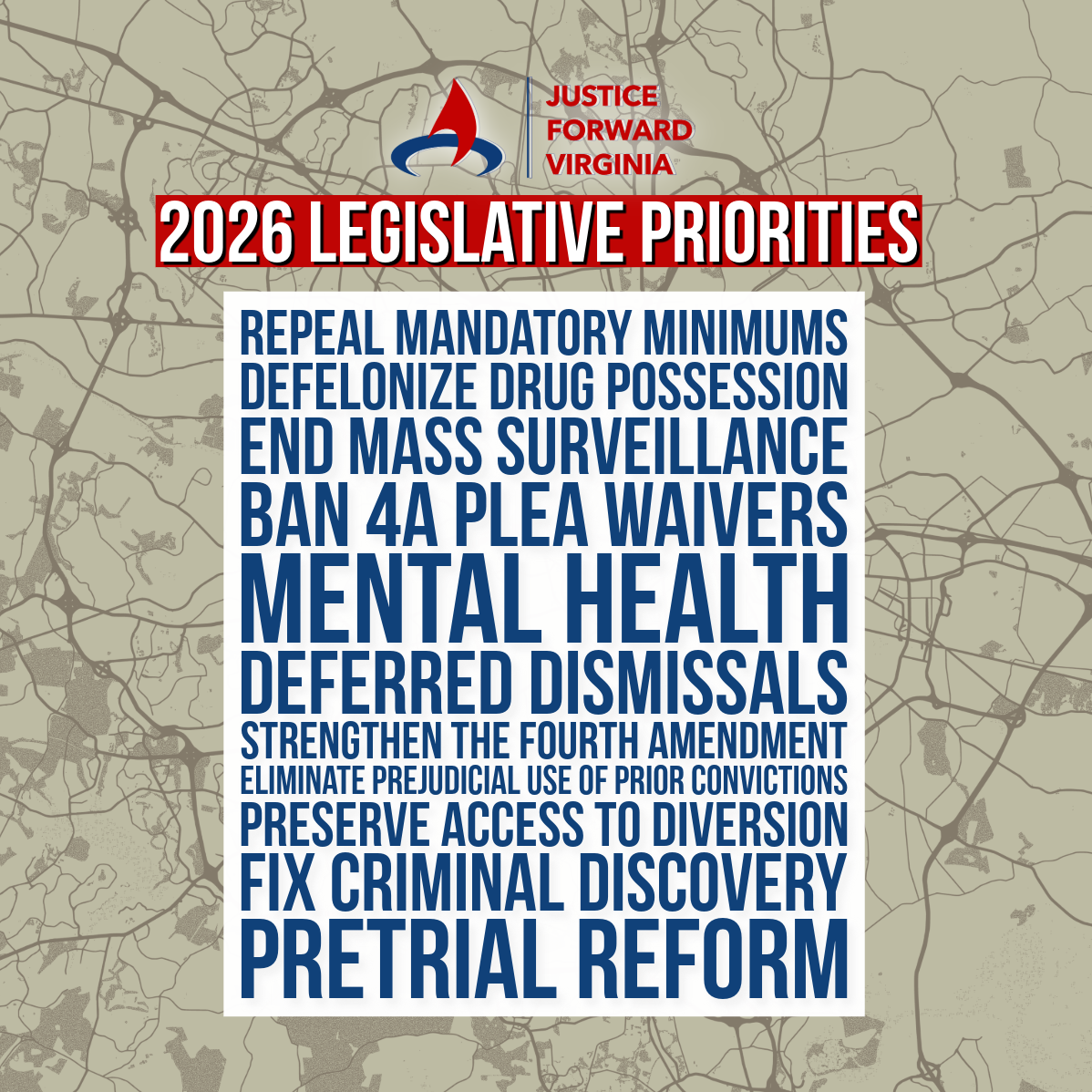
Over the last four years, the Virginia General Assembly passed some remarkable evidence-informed—and largely bipartisan—criminal justice reforms aimed to address basic unfairness, yet the Governor aligned himself with the harshest opponents of reform, vetoing most. The vetoed bills were not controversial. They aimed to address outdated laws and procedures that just don’t make sense. Virginians have been left well short of the type of contemporary, humane, evidence-informed practices and procedures that reflect their values. Criminal justice reform prevents harm to people and communities. It decriminalizes race, poverty, mental health, substance use, and disabilities. If our 2026 Legislative Priorities look familiar to you, that’s because many of these proposals have already passed the General Assembly! We’re looking forward to re-upping the solutions we’ve agreed will restore justice to our communities and courts, moving justice forward in Virginia.
Below is a list of our legislative proposals and—other legislation we support— going before lawmakers during the 2026 Virginia General Assembly Legislative Session. A smarter approach to criminal justice:
1) Repeal Mandatory Minimum Sentences: Mandatory minimums don't work. They don't reduce crime rates, they don't reduce recidivism rates, they don't make the court process more efficient, they aren't better for victims, and they don't even manage to hold people accountable for the crimes they actually committed. All they do is coerce defendants to plead guilty—including those who are innocent—and prevent judges from being fair in circumstances when fairness is warranted. Similar to a bill that passed the Senate in 2021, this proposal repeals most mandatory minimum sentences, including use of a firearm and possession of a firearm, assault on a law enforcement officer, and child sex crimes with life mandatory minimums.
2) Defelonize Drug Possession: Substance use is a public health issue, yet possession of most narcotics, including residue (trace amounts), is a felony offense in Virginia punishable by up to a decade in prison. We are still trying to punish our way out of a public health problem, even though research conclusively establishes that a carceral approach to substance use simply does not work. Virginia should start scaling back the War on Drugs in earnest by eliminating felony punishment for simple possession of all Schedule I and II drugs.
3) End Mass Surveillance: We oppose mass surveillance because of the serious and significant implications on our safety, the increasing abuse by law enforcement and government, the disparate impacts on minority communities, the potential this technology has to become another driver of mass incarceration, the growing costs of this new system on taxpayers. and the unavoidable access ALPRs provide to law enforcement, private parties, other states, and the federal government to an immense amount of highly sensitive data. We are also increasingly concerned over the long-term intentions of the private companies who have solicited elected officials in our state to help in building an expansive and seamless system of surveillance nationwide. The expansion of Automatic License Plate Readers (ALPRs) to Virginia’s highways has been rejected by the General Assembly for three years in a row. This proposal bans ALPRs by law enforcement agencies.
4) Ban Fourth Amendment Plea Bargain Waivers: In Virginia, some prosecutors push people to give up their Fourth Amendment rights when they enter into plea agreements. These plea bargain waivers permit law enforcement officers to stop and search individuals at any time for any reason. In Richmond, police records show 96% of those subject to Fourth Amendment plea waivers are people of color. We must ban this unconscionable and racist practice.
5) Protect People with Intellectual and Developmental Disabilities (ID/DD) and Mental Health Disorders—Amend 18.2-57(C): This minor amendment to 18.2-57 provides the possibility of an affirmative defense for individuals with mental illness or intellectual or developmental disabilities (such as autism spectrum disorder or dementia) who might assault a protected person such as a police officer or first responder. The amendment is a minor and potential opportunity for respite for those with ID/DD or mental illness where behaviors associated with the disorders may appear to be defiant but are a symptom of the disorder. Amending the statute does not prevent law enforcement officers from charging individuals who assault them, and does not apply if a protected person is seriously injured. It merely creates a slight layer of protection to our most vulnerable populations from arrest and prosecution where a disability or disorder may be the cause of disruptive behavior. Assaulting a protected person is currently punishable by up to five years in prison, with a mandatory minimum term of six months under Virginia law. The risk of acquiring this charge is great for families that may need to call first responders in the instance of a crisis. By amending the statute we improve public safety by creating a small opportunity to remove vulnerable people from our criminal justice system who do not belong there.
6) A Deferred Dismissal Should Not Depend On Payment of Costs: A deferred disposition allows people charged with a first-time offense to keep a conviction off their record after completing all the court’s requirements. Still, some people are convicted solely because they cannot pay court costs. A person who completes all the court's requirements except payment of costs should never keep a conviction.
7) Strengthen the Fourth Amendment, Protect People from Illegal Searches and Seizures: The Fourth Amendment requires that no warrant shall issue but upon probable cause. Yet, in practice, warrants are sometimes issued without the constitutionally required showing. In Mapp v. Ohio, the United States Supreme Court ruled that, in order to protect our Fourth Amendment rights, evidence obtained from illegal searches and seizures must be suppressed in state court cases. 367 U.S. 643 (1961). However, in 1983, the United States Supreme Court significantly reduced those protections by creating the "good faith" exception to the exclusionary rule. See, United States v. Leon, 468 U.S. 897 (1984). As a result, evidence obtained from an unconstitutional warrant is admissible as long as police reliance on the warrant is deemed "objectively reasonable." In response, several states (applying their own constitutions) have rejected the Leon "good faith" exception as incompatible with their constitutional protections against unreasonable searches and seizures. Virginia has long provided a statutory suppression remedy for unlawful searches and seizures - Va. Code § 19.2-60. This statute pre-dates Leon and contains no "good faith" exception. This proposal clarifies that Va. Code § 19.2-60 operates as an independent statutory suppression remedy and does not permit admission of evidence obtained by an unconstitutional warrant based on a claim of "good faith."
8) Eliminate the Prejudicial Use of Prior Convictions at Trial: The rules of evidence require jurors to decide whether a person is guilty based on the facts of the case. This bill closes a loophole that allows jurors to decide whether a person is guilty based on events that happened in the past. If the person is convicted, the previous convictions would still be used to enhance the person’s sentence, but they would not be allowed to influence the jury’s decision of whether the person is guilty of the crime charged.
9) Preserve Access to Diversion: The Virginia Supreme Court has made clear that lower courts cannot refer people charged with felonies pending in district court to behavioral health dockets. This bill would allow behavioral health dockets to address people with mental health disorders, substance use and disabilities in the appropriate court.
10) Fix Discovery: This bill would require prosecutors to provide criminal discovery materials to the defense by electronic means, whenever possible. The bill passed the Senate unanimously and House overwhelmingly in the General Assembly in 2025 and was vetoed by Governor Youngkin.
11) Advance Urgent Pretrial Reforms:
I. Counsel at First Appearance - CAFA: Research tells us that how quickly a person is released after arrest can have a profound impact on the outcome of their criminal case. Unfortunately, in Virginia, our pretrial system leads to people, especially poor people, being held unnecessarily for days before they can be released simply because they are not appointed a lawyer in a timely manner. By allowing and ensuring that individuals have an attorney when they first appear in front of a judge, bail can be considered immediately. And if a person is eligible for bail, they can return home, often within a day of their arrest, while the charges are pursued. Not having access to an attorney who can request bail, either because a public defender or court appointed counsel hasn’t been assigned or because of the jurisdiction’s policy, leads to additional and unnecessary time that a person–who has not been convicted–is being held in jail.
II. Expand Research Opportunities for Pretrial Data-VLDS: During the 2021 legislative session, the General Assembly passed Pretrial Data Project bills, HB 2110 and SB 1391, which require the Virginia Criminal Sentencing Commission (VCSC) to collect and disseminate, on an annual basis, statewide and locality-level data related to adults charged with criminal offenses punishable by confinement in jail or a term of imprisonment. Currently the Pretrial Data Project is not linked with any other data outside the pretrial legal system, such as data on defendants’ employment, housing, or education. The Virginia Longitudinal Data System (VLDS) is a protected platform for linking distinct state agency datasets for research uses by verified researchers. If authorized by legislation, the VCSC could contribute the Pretrial Data Project to the VLDS and thus could provide linked, anonymized data to researchers.
III. Reform Failure to Appear (FTA): Currently in Virginia, if you miss a court date, or even in some instances are late to a court date, you can be charged with a separate criminal offense for failure to appear. People miss court for many reasons outside of their control–they can’t miss work, their childcare failed to show up, they don’t understand court instructions, etc. Yet individuals are routinely seen through the eyes of the law as fugitives from justice and are met with unduly harsh punishments. The proposal eliminates the crime of felony failure to appear, reduces misdemeanor FTA punishment from 12 months to 30 days, and defines “willfully failure to appear” as “intentional conduct with a purpose to avoid the judicial process.” The proposal also requires courts to consider mitigating circumstances when deciding whether a person has willfully failed to appear.
Additional Legislation:
Require Appellate Courts to Examine Whether the Evidence at Trial was Sufficient to Convict
Reverse Bad SCOVA Expungement Cases
Ensure Expungement Eligibility for Deferred Dismissals
Align Class 5 & 6 Robbery Offenses with the Rest of the Code
Allow Defendants to Withdraw Requests for Jury Sentencing and Ask Jurors About Potential Sentences
Ensure Confidentiality of Restorative Justice Practices
Probation Fix–Uphold Reforms for Technical Violations of Probation
Mental Health Evidence Fix
Crediting Time Served on Dismissed Cases
Alternative (non-police) Crisis Response
OCRA
Pay Parity for Public Defenders
Require Tracking and Disclosure of Jailhouse Snitch Testimony
Juvenile Expungement
JIRC Reform
Other Legislation We Support:
Equitable Regulated Marijuana Market
Remedy for Extreme Sentencing - Second Look, parole reform, etc.
Voting Rights Restoration (Constitutional Amendment)
Allow People Previously Convicted of a Felony or on Bond to be Released on Unsecured Bonds
Marijuana Resentencing
Youth Decrim
Ensure Incarcerated People Have Access to Counsel
Establish Minimum Age of 11 for Charging Youth with Criminal Offenses in Juvenile & Domestic Relations Court
End the Use of Restorative Housing (solitary confinement) in Adult and Youth Facilities
Prohibit the Placement of Youth in Adult Jails and Prisons
Move Department of Juvenile Justice (DJJ) to the Health Secretary
Remove the Cap on Youth Access to Diversion
Reduce Burdensome Fines and Fees